
How to Set New Year Goals You'll Actually Keep (7 Steps)
How many goals to pick, how to word them, and how to check in on them during the year.
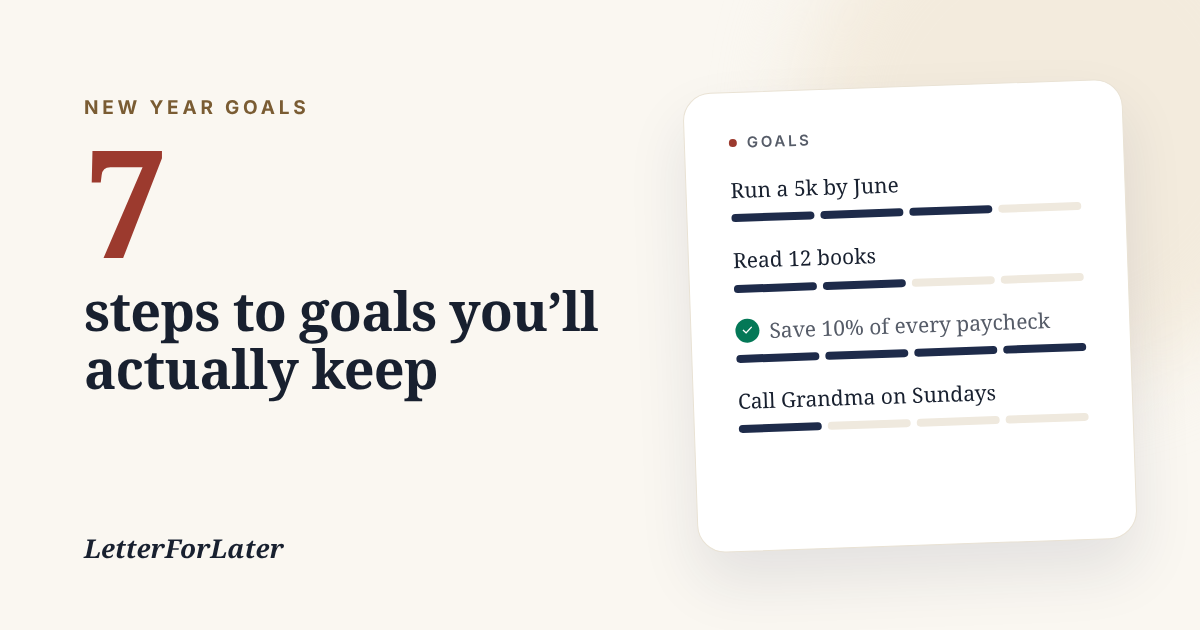
To set New Year goals you will actually keep, choose three to five, write each one as something to do rather than something to stop, make it specific enough to check, decide when and where you will work on it, and plan a check-in halfway through the year. Writing them down and recording your progress makes the biggest difference of all.
None of this needs a planner or an app. It takes about half an hour, ideally in the last days of December or the first week of January, when a new year makes a fresh start feel natural. Researchers at Wharton call that the fresh start effect: people are more likely to work on their goals after landmarks like a new year, a new month or a birthday.
Step 1: Look back before you look ahead
Good goals come from the year you just had. Spend ten minutes on a few questions: what went well, what drained you, what you kept meaning to do and didn't. If a goal keeps showing up year after year, that tells you something too: either it matters a lot, or it was never really yours.
If you want a longer list, use these end-of-year reflection questions.
Step 2: Pick three to five goals
Every goal competes for the same evenings and weekends. With ten goals, none of them gets enough attention, and by February the list feels like a reproach. Three to five gives each one a real chance.
A simple way to choose: write down everything you would like to change, then circle the ones that would still matter to you in December. Keep those.
Step 3: Aim for something, not away from something
How you phrase a goal matters. In a study of 1,066 people's New Year's resolutions, published in PLOS ONE in 2020, 58.9% of those with "approach" goals said they had kept them a year later, against 47.1% of those with "avoidance" goals.
An approach goal is something to do. An avoidance goal is something to stop or avoid:
- Instead of "stop eating junk food", try "cook dinner at home four nights a week".
- Instead of "spend less time on my phone", try "read for twenty minutes before bed".
- Instead of "stop being so stressed", try "walk outside for half an hour at lunch".
The new version gives you something to do on a Tuesday evening. "Not doing" something is hard to practise.
Step 4: Make each goal specific enough to check
A goal is specific enough when someone else could tell whether you did it. "Get fit" can't be checked. "Run a 5k by June" can.
| Vague | Specific |
|---|---|
| Get fit | Run a 5k by June |
| Read more | Read 12 books this year |
| Save money | Put 10% of every paycheck into savings |
| See friends more | Have dinner with a friend once a month |
| Learn Spanish | Practise Spanish for 15 minutes, five days a week |
A date or a number is usually all it takes. If you know the SMART method (specific, measurable, achievable, relevant, time-bound), this is the part that matters most.
Step 5: Decide when and where
A goal says what you want. A plan says when it happens. Psychologists call these "if-then" plans or implementation intentions: "If it's Monday after work, I go to the pool." "If I sit down on the train, I open my Spanish app."
A 2006 review of 94 studies found that people who made plans like these reached their goals more often than people who only set the goal. Later reviews found a smaller effect than the first one, but still a helpful one, and it costs one sentence per goal.
Step 6: Write your goals down and record your progress
Write your goals somewhere you will see them again, then keep track of how far along each one is. A review of 138 studies published in Psychological Bulletin found that monitoring progress helps people reach their goals, and that it helps more when the progress is physically recorded or shared with someone.
Recording doesn't need to be elaborate. A rough percentage once a month is enough: 0, 25, 50, 75 or 100. What matters is that you look.
Step 7: Plan a check-in halfway through the year
Most goals don't fail in one dramatic moment. They fade in February and are forgotten by summer. A check-in on 1 July catches them while there is still half a year left.
At the check-in, look at each goal and decide: keep going, change it, or drop it. Dropping a goal that no longer fits is a decision, not a failure. Here are 15 questions for a mid-year check-in.
You can also set your goals online and we will email you on 1 July to check in on them. Marking your progress takes one tap, without signing in.
An example set of New Year goals
Here is what the whole thing looks like for one person:
- Run a 5k by June. If it's Tuesday, Thursday or Sunday morning, I run before breakfast.
- Read 12 books this year. If I get into bed, I read for twenty minutes before I touch my phone.
- Put 10% of every paycheck into savings. If my salary arrives, the transfer goes out the same day, automatically.
- Call Grandma every Sunday. If it's Sunday after lunch, I call her.
Four goals, each one specific, each one something to do, each with a time attached.
Mistakes to avoid
- Too many goals. A long list feels ambitious on 1 January and impossible by March.
- Goals you think you should have. If a goal is really someone else's idea, it will be the first to go.
- All or nothing. Missing a week doesn't end a goal. Pick it up the next Monday, which is a fresh start of its own.
- Never looking at them again. A goal you don't check is a goal you have quietly dropped.
Keep your goals with a letter
Goals say what you want to do. They don't say why. A short New Year letter to your future self keeps the reason: where you are now, what you hope will change, and what you want to remember on a hard day. Write both and read them together when the letter arrives.
Set your goals for the new year. It takes a few minutes, and it's free.
Frequently asked questions
How many New Year goals should I set?
Three to five. Fewer goals get more of your time and attention, and a short list is easier to check on during the year. If you have more ideas than that, keep the rest on a separate list for later.
When is the best time to set New Year goals?
The last week of December or the first week of January, when a new year makes a fresh start feel natural. If you miss it, the start of any month works too: research on the fresh start effect found that people also work harder on their goals after the start of a new month or week.
Should I write my goals down?
Yes. Writing goals down and recording your progress makes them easier to follow. A review of 138 studies found that monitoring progress helps people reach their goals, especially when the progress is recorded.
What should I do if I fall behind on a goal?
Look at it honestly at your next check-in and decide whether to keep going, make it smaller or drop it. Falling behind in February is normal. What matters is picking it back up, or letting it go on purpose.
Now, set your own goals
Write them down here. We’ll check in with you halfway through the year.
Or start from a guide
For a child
A letter to my daughter
The things you want her to know that don’t fit into an ordinary day — delivered on a birthday you choose.
Open the guide arrow_forwardFor a child
A letter to my son
What you want him to know, saved for the moment it will actually land.
Open the guide arrow_forwardKeep reading
All articles arrow_forwardNew Year's Resolutions vs Goals: What's the Difference?
Why resolutions fade, and how to turn yours into goals you can check, with 8 examples.
Read arrow_forwardMid-Year Goals Check-In: 15 Questions to Ask Yourself
A 30-minute routine and 15 questions to review your goals halfway through the year.
Read arrow_forwardNew Year Letter to Yourself: 50 Prompts to Look Back and Look Ahead
Fifty questions to help you write a New Year letter to your future self, grouped by the parts of a good letter.
Read arrow_forward