
New Year's Resolutions vs Goals: What's the Difference?
Why resolutions fade, and how to turn yours into goals you can check, with 8 examples.
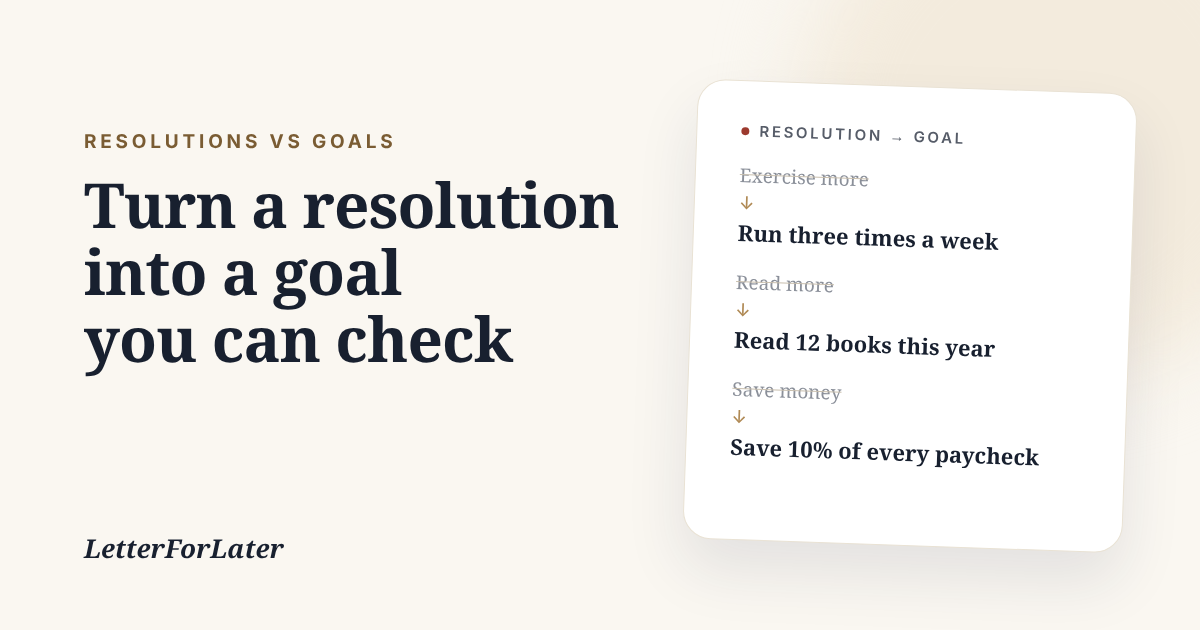
A New Year's resolution is a promise to change something about yourself, usually open-ended: "exercise more", "be less stressed". A goal is a specific result you can check, with a deadline: "run a 5k by June". Resolutions describe the person you want to be; goals describe what you will do to get there. The most useful approach is to keep the resolution as the reason and turn it into one or two goals.
The difference at a glance
| Resolution | Goal | |
|---|---|---|
| Sounds like | "I'll exercise more." | "I'll run a 5k by June." |
| How you know it worked | Hard to say | You did it or you didn't |
| Timeframe | Usually none | A date |
| After a bad week | Feels broken | You are behind, and you can catch up |
| Best for | Deciding what matters | Deciding what to do next |
Why resolutions fade
Resolutions aren't a bad idea. In a year-long study of 1,066 people, 55% said they were still keeping their resolutions a year later. But many people drop theirs within weeks. Strava, the fitness app, looked at its users' activity and named a day in mid-January "Quitter's Day", when many New Year fitness resolutions stop.
The usual reasons have little to do with willpower:
- They are too vague to check. With "eat healthier", every meal is a judgement call, and after a few bad ones it feels like the resolution is already broken.
- They are all or nothing. One missed week and the whole thing feels lost.
- They have no plan attached. "Exercise more" doesn't say when.
- Nobody looks at them again. A resolution made on 1 January is rarely reread in March.
Goals fix most of this because they can be checked, they can be partly done, and they come with a time and a place.
How to turn a resolution into a goal
- Ask what it would look like in real life. If you kept "exercise more" all year, what would you have done?
- Add a number or a date. Three runs a week. A 5k by June. 12 books by December.
- Make it something to do, not something to stop. The same study found that goals to do something were kept more often (58.9%) than goals to stop or avoid something (47.1%).
- Decide when and where. "If it's Tuesday after work, I go for a run." A plan like this turns a good intention into a time in your week.
Examples: resolution to goal
| Resolution | Goal |
|---|---|
| Exercise more | Run three times a week and finish a 5k by June |
| Eat healthier | Cook dinner at home four nights a week |
| Read more | Read 12 books this year, one a month |
| Save money | Put 10% of every paycheck into savings |
| Spend less time on my phone | Read for 20 minutes before bed instead of scrolling |
| Be a better friend | Have dinner with a friend once a month |
| Learn something new | Finish one online course by September |
| Be less stressed | Walk outside for 30 minutes at lunch on weekdays |
Keep both
You don't have to choose. The resolution is the reason ("I want to feel stronger this year") and the goals are how you get there ("run a 5k by June", "go to the pool on Mondays"). When a goal stops working, the resolution tells you what to replace it with.
The reason is also the part people forget first. Writing it down in a New Year letter to your future self keeps it: why it mattered, who you were when you decided, and what you hope will be different. Your goals can travel with the letter and arrive on the same day.
Next: set them and check in
Once your resolutions are goals, write them down, keep track of how far along each one is, and look at them again halfway through the year. Our guide on how to set New Year goals you'll keep covers each step.
Set your goals for the new year. We email you on 1 July to check in. It's free.
Frequently asked questions
Is a goal better than a resolution?
A goal is easier to keep because you can check it and plan for it. A resolution is still useful as the reason behind your goals. The best approach is to keep the resolution and turn it into one or two specific goals.
Why do most New Year's resolutions fail?
Mostly because they are vague, all or nothing, and never looked at again. A resolution like "eat healthier" gives you no clear way to tell whether you are keeping it, so a few bad days can make it feel broken.
What is a SMART goal?
SMART stands for specific, measurable, achievable, relevant and time-bound. In practice, a goal with a clear action, a number and a date ("read 12 books by December") covers most of it.
How many resolutions or goals should I have?
Three to five goals is plenty. Fewer goals get more of your attention, and a short list is easier to check on during the year.
Now, set your own goals
Write them down here. We’ll check in with you halfway through the year.
Or start from a guide
For a child
A letter to my daughter
The things you want her to know that don’t fit into an ordinary day — delivered on a birthday you choose.
Open the guide arrow_forwardFor a child
A letter to my son
What you want him to know, saved for the moment it will actually land.
Open the guide arrow_forwardKeep reading
All articles arrow_forwardHow to Set New Year Goals You'll Actually Keep (7 Steps)
How many goals to pick, how to word them, and how to check in on them during the year.
Read arrow_forwardMid-Year Goals Check-In: 15 Questions to Ask Yourself
A 30-minute routine and 15 questions to review your goals halfway through the year.
Read arrow_forwardNew Year Letter to Yourself: 50 Prompts to Look Back and Look Ahead
Fifty questions to help you write a New Year letter to your future self, grouped by the parts of a good letter.
Read arrow_forward